
Acupuncture for Insomnia: How Does It Help You Sleep?

Acupuncture for insomnia works by calming an overactive nervous system and helping to regulate the hormones that control sleep. Needles placed at specific points can shorten the time it takes to fall asleep and improve how restful your sleep feels. At Acubody in Holborn, in central London, and Grove Park, Lewisham, we pair acupuncture with acupressure points for sleeplessness and simple lifestyle changes, for results that last beyond the treatment room.
In short
- Acupuncture for insomnia is supported by several clinical trials measuring sleep quality and time to fall asleep
- Sessions usually involve needling calming points on the scalp, wrist, ankle and ear
- Acupressure points for sleeplessness can be used at home between visits
- Most people notice a change in their sleep pattern within four to six weekly sessions
- Not suitable for everyone. See the suitability note below
How does acupuncture help with insomnia?
Insomnia is rarely just about the hours you spend in bed. It is usually a sign that the nervous system is stuck in an alert state. Acupuncture appears to work on this directly. Trials using electroacupuncture have found it raises serum melatonin levels and lowers cortisol, the stress hormone that keeps the body on edge at night PMC, 2025. A large meta-analysis of fifteen randomised controlled trials found acupuncture produced a significant improvement on the Pittsburgh Sleep Quality Index, a standard measure of sleep quality, compared with medication alone (PubMed, 2021). A more recent 2025 review of chronic insomnia disorder, covering 757 patients across ten trials, found acupuncture improved both sleep quality scores and objective measures such as sleep efficiency and time spent awake after falling asleep (PMC, 2025). The National Center for Complementary and Integrative Health, part of the US National Institutes of Health, includes acupuncture among the approaches with evidence for improving sleep (NCCIH).
What happens during a session for sleeplessness?
Your first appointment starts with a full case history. We ask about your sleep pattern, stress levels, diet, medication and any underlying health conditions. Insomnia often sits alongside anxiety, menopause, pain or digestive trouble so all these need to be taken into consideration. Fine needles are then placed at points chosen for your presentation and left in for around 20 to 30 minutes while you rest. Many people find this part of treatment deeply relaxing, even before any change in sleep appears.
Which acupressure points for sleeplessness can help?
Between sessions, gentle pressure on certain points can support your progress. Anmian, located behind the ear, is a traditional point for calming the mind before bed. Shenmen, at the wrist crease in line with the little finger, is another pressure point for sleeplessness used to settle a racing mind. Yintang, between the eyebrows, is commonly used for stress-related wakefulness.
We show patients how to use these acupressure points for sleeplessness safely at home, as part of a wider plan rather than as a stand-alone fix. The points that will be effective for you will depend on the pattern, the reason for the sleep disturbance. Although the points above are commonly used they may not be the best for everyone, so don’t give up if they don’t help you.
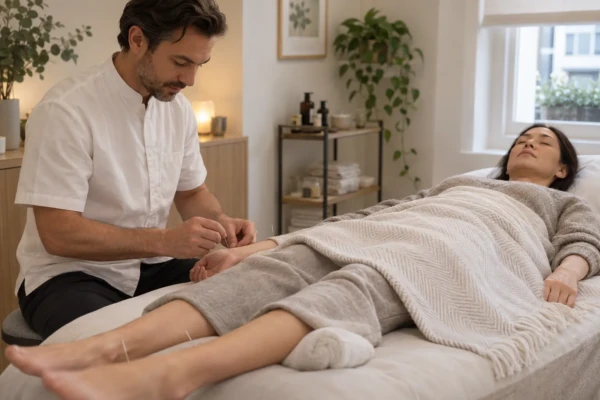
What we see with insomnia
In practice, we often see people who have tried sleep hygiene advice, medication or both, and still lie awake at 3am with their mind racing. What tends to shift first is not always total sleep time. It is often the quality of sleep and how rested a person feels the next day.
Patients frequently describe fewer night wakings and an easier time settling back to sleep if they do wake. Progress is rarely instant. We usually plan for a course of sessions and review your response along the way, adjusting the approach based on what is or is not working for you.
Who acupuncture for insomnia may not suit
Acupuncture is generally safe, but it is not right for everyone. It may not be suitable if you are in the first trimester of pregnancy, have a bleeding disorder or take strong blood-thinning medication, have a pacemaker, or have a severe needle phobia. Insomnia caused by undiagnosed sleep apnoea, thyroid problems or a mental health crisis needs medical assessment first, alongside or instead of acupuncture. We will always ask about your medical history before treating you, and refer you back to your GP where appropriate.
About your practitioner
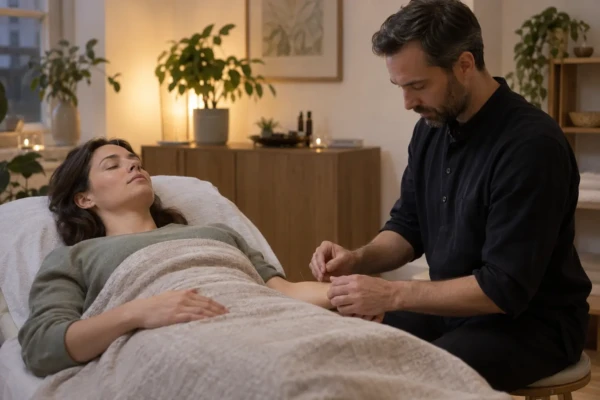
Duncan McGechie (BA, MSc, Grad Dip, MBAcC, MBMAS, MRCHM, MISRM, FHEA) has practiced acupuncture and Chinese medicine since 2003, at our acupuncture clinics in London. He is currently working from London Natural in Holborn and the Acubody Therapies studio in Grove Park, Lewisham. The Holborn clinic is within 10 mins walk of Holborn, Chancery Lane, Farringdon tube, right by Gray’s Inn and Red Lion square. The Grove Park Studio is in a peaceful garden setting well situated for Blackheath, Hither Green, Lee, Eltham, and Bromley.
He is a member of the British Acupuncture Council, the British Medical Acupuncture Society, the Register of Chinese Herbal Medicine and the Institute of Sports and Remedial Massage. He has treated patients in London for over two decades and holds more than 200 five star Google reviews. Read Duncan’s full profile.
Cost and booking
For current prices and our cancellation policy, see our prices page. You can book an appointment online at our Holborn WC1 or Lee/Grove Park SE12 clinics, or contact us with any questions first.