 by admin
 8 August 2026
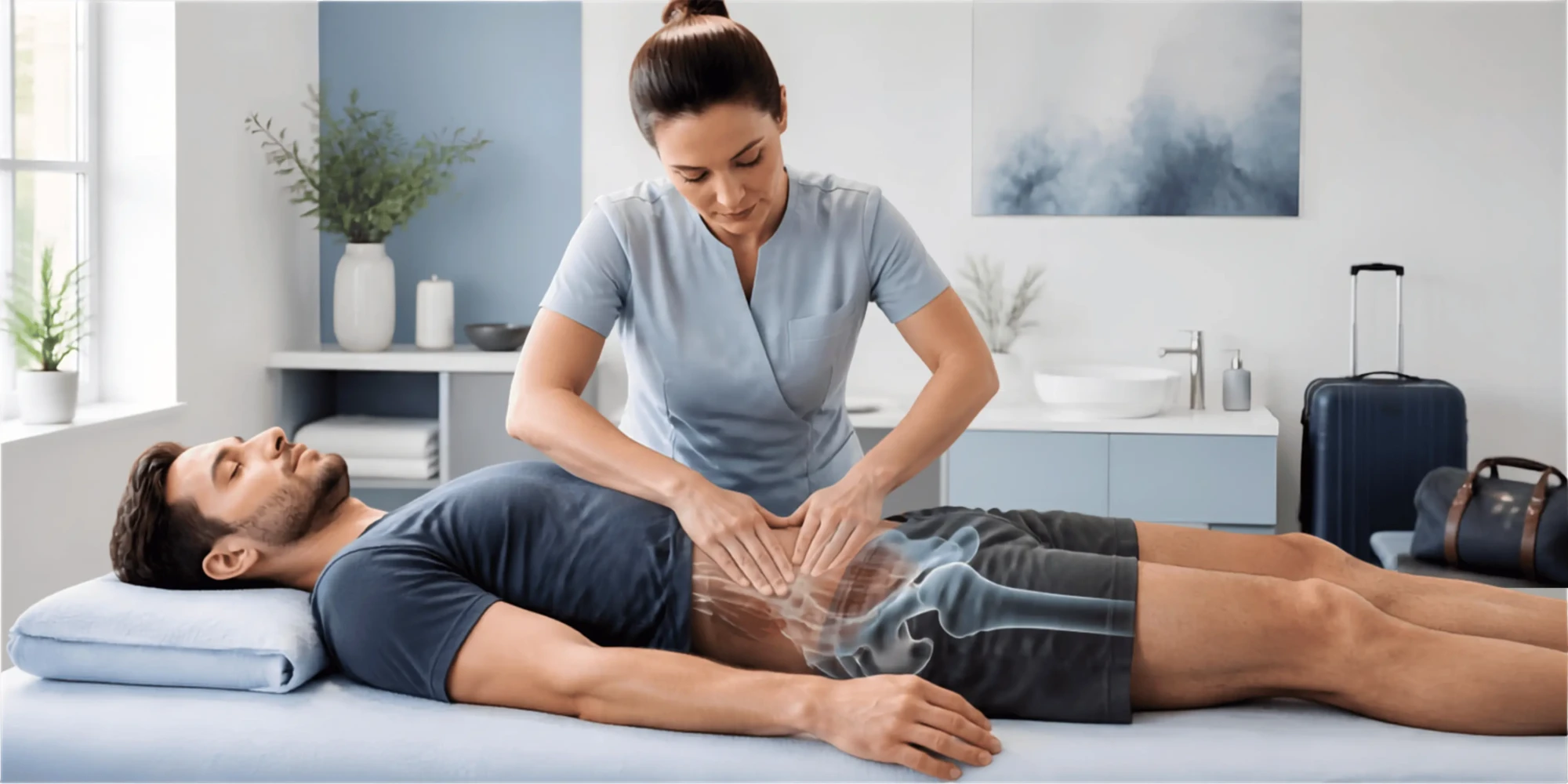
You are feeling rejuvenated after a journey and board your flight home, but as soon as you get up from your seat to collect your baggage, stiffness takes hold of your lower back. Many hours in compact airline seats, long drives, or lying on comfortable sunbeds can make holiday travellers suffer from a locked pelvis region. When clients walk into my clinic struggling to stand up straight after travelling, they frequently ask: what does myofascial release therapy treat when standard stretching fails to yield results?
The answer often lies deep within the pelvis, specifically with a pair of powerful muscles known as the psoas major.
Understanding Psoas Freeze After Long Journeys
The psoas is your primary hip flexor, connecting your lumbar spine directly to the top of your thigh bone. When you sit for extended periods, the psoas remains in a chronically shortened position.
If you hold that posture for hours under the vibration and mild stress of travel, the surrounding fascia, the continuous web of connective tissue wrapping around every muscle fibre, adapts to that shortened state. Upon standing, the fascia essentially shrink-wraps around the psoas. Instead of lengthening smoothly, the tight tissue pulls directly on your lower lumbar vertebrae, tipping your pelvis forward and locking your back into a painful, arching strain.
This deep restriction is what I refer to as psoas freeze. Because the tissue has lost its natural elastic glide, forcing yourself through aggressive back bends or basic standing stretches only causes the surrounding back muscles to spasm in defense.
How Myofascial Release Releases Deep Pelvic Tension
My approach at Acubody involves integrating hands-on bodywork and acupuncture to treat your spine’s captors:
- Slow, Directional Melting: Unlike friction-based softening, myofascial release involves applying slow and directional pressure on the anterior hip flexors and the thoracolumbar junction. It tells the body to lower the tension.
- Releasing Adhesions: With the freeing of the adhesions between the iliacus, psoas, and abdominal fascia, the pelvis resumes its normal tilt, thereby removing mechanical stress from your lower spine.
- Signaling the Body to Lower Tension: The sympathetic system is kept engaged by travel stress and tends to keep the psoas tight. Hands-on fascial work sends a signal of safety to the brain via the vagus nerve.
Integrating Acupuncture for Lasting Relief
Manual release gives access to the physical muscles, but when combined with acupuncture that is specifically targeted, this combination ensures that results are retained in the long term. In the same way that people suffering from neurovascular tension would ask whether acupuncture is effective for migraines, the same applies to chronic muscle spasm and the needling of the motor points. Needle insertion at key motor points resets muscle spindle activity, clears inflammatory stagnation, and encourages smooth blood flow through the deep pelvic basin.
Working within the British Acupuncture Council (MBAcC), which is recognised by the Professional Standards Authority (PSA), I guarantee that each treatment provides you with a safe and clinically proven treatment for your structural issues.
Ready to Move Comfortably Again?
You shouldn’t have to spend the weeks following your holiday suffering from a stiff, locked lower back. Myofascial release offers a targeted, non-invasive way to unwind deep psoas tightness and restore your body’s natural freedom of movement.
If stiffness after travel has been hindering you, then make sure to schedule your first appointment now at either Acubody in Holborn or our clinic at Grove Park, Lewisham. Should you have any concerns regarding your condition, do not hesitate to contact me for a quick chat.